House rendering in Romford, Essex and London
We render and repair the outside walls of houses in Romford, Hornchurch, Upminster, Brentwood and across Essex and London. We specialise in silicone render, using Weber products, and we also repair and paint existing render. Eli holds an NVQ Level 2 in rendering and leads the work himself. He comes to see the house for free and gives you a written, fixed-price quote before we start.
What we do
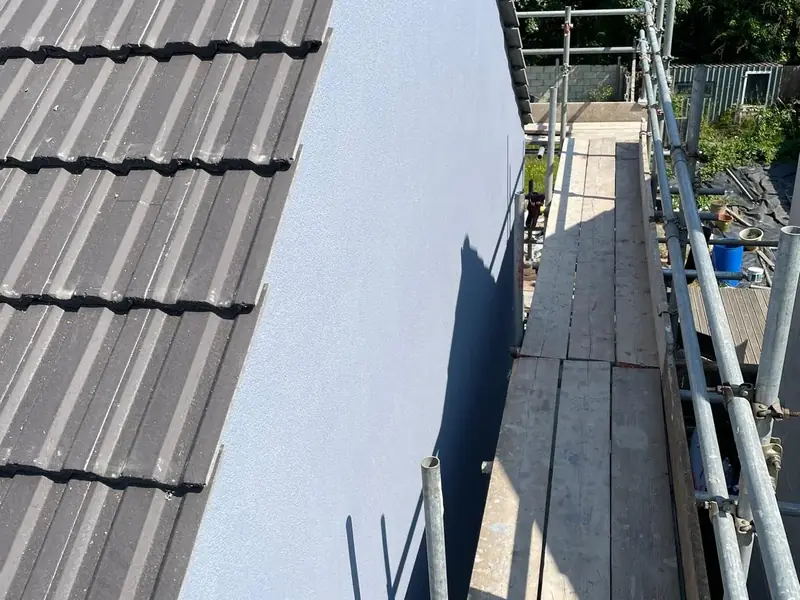
Silicone render
A thin-coat render, coloured all the way through, that repels water and keeps its colour.
Render repairs
Cracked, hollow or damaged render cut out and patched to match the wall around it.
Painting render
Rendered walls painted, or tired render refreshed with a new coat in the colour you want.
Learn more
Why silicone render
Silicone render is a thin coat with silicone added, so rain runs off rather than soaking in. Because the colour runs all the way through, it doesn't need painting to look finished. We use Weber's silicone products and don't do monocouche or sand-and-cement render, so you get one system, applied by someone trained in it.
Who does the work
Rendering is done by our own team, led by Eli, who holds an NVQ Level 2 in rendering. Eli quotes for the job and leads the team that does it.
Repair or re-render?
If the cracks are in a few places and the rest of the render is sound, the damaged sections can be cut out and patched. If large areas sound hollow when tapped, are coming away from the wall or let water in, re-rendering is usually the better answer. Eli checks the walls at the site visit and tells you which you need.
When can you render a house?
Render needs the right weather to set properly. Weber's guidance for its silicone render is:
- not below 5°C or above 30°C
- not if frost is forecast within 24 hours
- not in damp or wet conditions, or on walls in direct hot sun
- ideally, about 36 hours of dry weather afterwards so it can start to cure
That makes spring to early autumn the most reliable time. In colder or wetter months, a job may need to wait for the right days.
Do you need planning permission?
Often not. The Planning Portal says rendering is usually allowed without permission if the finish looks similar to the materials the house was built with. You'll need planning permission if your home is in a conservation area, or if the new render changes how the house looks, for example a different material or colour. Listed buildings need listed building consent. In Romford, that includes houses in the Gidea Park Conservation Area, so check with Havering Council first.
Looking after render
Keep gutters and downpipes clear, because water running down a wall is a common cause of marks on render. Small cracks are quicker and cheaper to repair early, before water gets behind them.
What affects the price
- The size and height of the walls.
- Access, such as whether scaffolding is needed.
- The state of the existing walls or render, and how much needs taking off or repairing.
- Details around windows, doors and corners.
- The colour and finish you choose.
Eli prices all of this at the site visit and writes it into a fixed-price quote.
How a rendering job runs
Tell us about the house — use the quote form, call or send a WhatsApp, with photos of the walls if you have them.
Free site visit — Eli looks at the walls and the state of any existing render.
Written, fixed-price quote — what's included and the price, with the 12-month workmanship guarantee written in.
The work — walls prepared, then rendered or repaired.
Handover — Eli goes through the finished walls with you.
Where we render
We're based in Romford and render houses across Romford, Hornchurch and Upminster, Brentwood and Loughton and Chigwell.
In a conservation area, rendering the outside of a house needs planning permission, and there are plenty nearby: 11 in Havering, 13 in Brentwood and 26 in Epping Forest. Further into London, Article 4 directions on some roads in Richmond cover rendering brickwork, and in parts of Forest Gate they cover cladding and pebble-dashing.
For jobs in central London, travel and parking costs are added to the quote.
Rendering questions
How much does it cost to render a house?
It depends on the size and height of the walls, access and scaffolding, the state of the existing walls, and the finish you choose. Eli gives you a written, fixed-price quote after the free site visit.
What is silicone render?
It's a thin-coat render with silicone added, which helps it repel water and keep its colour. It comes ready-coloured, so it doesn't always need painting.
Do you do monocouche or sand-and-cement render?
No. We specialise in silicone render, using Weber products.
What time of year can you render?
Weber's silicone render shouldn't go on below 5°C or above 30°C, in wet weather or with frost forecast within 24 hours. Spring to early autumn is usually the most reliable time.
Do I need planning permission to render my house?
Not usually, if the render looks similar to the house's existing materials. You'll need permission in a conservation area or if the look changes, and listed building consent for a listed home.
Can you repair my existing render?
Yes. Cracked or damaged sections can be cut out and patched. Eli will tell you at the site visit whether a repair is enough or the wall needs re-rendering.
Can you paint render?
We can. We paint rendered walls, and tired render can be refreshed with a new coat.
Who does the rendering?
Eli, who holds an NVQ Level 2 in rendering, with our own team.
Is the work guaranteed?
Our workmanship is guaranteed for 12 months, and the guarantee is written into your quote.
Do you charge for the site visit?
No, the visit is free.
Thinking about rendering?
Tell us about your house and Eli will get back to you within 24 hours.