What to check before rendering a house
By Eli Gjoka · Updated
Short answer
Before a house is rendered, check four things: the state of the walls, whether you need planning permission, whether building regulations apply, and the weather. Most problems with new render start with a wall that wasn't sound or a job done in the wrong conditions. Eli checks the walls at a free site visit and tells you what your house needs before you get a quote.
On this page
1. The state of the walls
Render is only as good as the wall underneath it. Walk round the house and look for:
- Hollow render. Tap the existing render. If it sounds hollow, it has come away from the wall and needs to come off.
- Cracks. Fine cracks in a few places can often be cut out and patched. Long cracks, or cracks that keep coming back, need a closer look.
- Damp. Damp patches, green staining or salt marks show water is getting in. Find the cause first, or it will spoil the new render.
- Loose brickwork or pointing. Anything loose is repaired before rendering.
- Gutters and downpipes. A leaking gutter or a downpipe that runs down the wall will mark new render quickly.
2. Repair or re-render?
If the damage is in a few places and the rest of the render is sound, the bad sections can be cut out and patched. If large areas are hollow, coming away or letting water in, re-rendering is usually the better answer. Eli tells you which you need at the site visit.
3. Planning permission
In England, the Planning Portal says you can usually render without planning permission if the finish looks similar to the materials the house was built with. You do need permission in a conservation area, and a listed building needs listed building consent.
Some areas also have an Article 4 direction, which removes some of these rights. In Romford, Gidea Park is both a conservation area and covered by an Article 4 direction. If you're not sure about your house, check with your council before the work is booked.
4. Building regulations
The Planning Portal says that where 25% or more of an external wall is re-rendered, building regulations would normally apply, and the wall's insulation would normally have to be improved. This matters most on a full re-render. Your council's building control team can tell you what applies to your house.
5. The weather and time of year
Render needs the right conditions to set properly. Weber's guidance for its silicone render is not below 5°C or above 30°C, not if frost is forecast within 24 hours, and not in wet weather or on walls in direct hot sun. That makes spring to early autumn the most reliable time. In colder or wetter months, a job may need to wait for the right days.
6. The details round the house
- Window sills. Sills need to stand out far enough from the new render to throw water clear of the wall.
- Pipes, vents and meter boxes. Anything fixed to the wall may need moving or refitting.
- Edges and corners. Beads at corners, window and door openings and along the bottom of the render keep the edges neat and straight.
- Access. Most houses need scaffolding, and on a semi or terrace the neighbours should know when it's going up.
7. The finish and colour
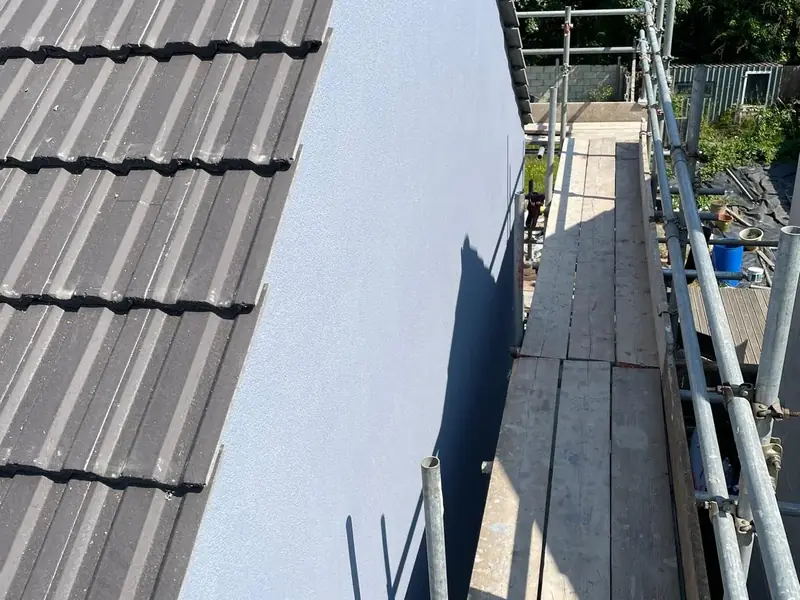
Silicone render is coloured all the way through and repels water, so it doesn't need painting to look finished. If you're choosing a colour, look at a sample on your wall in daylight before you decide. If you have render that's still sound but tired, painting it may be all it needs.
Planning work like this?
Eli comes to see the job for free and gives you a written, fixed-price quote.
Common questions
Can you render over old render?
Sometimes, if the old render is sound and well bonded. Hollow or loose render has to come off first.
Do I need planning permission to render my house?
Usually not, if the finish looks similar to what the house was built with. You do in a conservation area, and a listed building needs consent.
What time of year is best for rendering?
Spring to early autumn, when it's dry and not too cold or too hot.
What render do you use?
We use Weber's silicone render. Eli holds an NVQ Level 2 in rendering and leads the work himself.
How much does it cost to render a house?
It depends on the size and height of the walls, access, the state of the existing walls and the finish you choose. Eli gives you a written, fixed-price quote after the free site visit.